On May 16, 1691, in a drizzling rain, two middle-aged men climbed gallows erected at present-day One Pace Plaza near the Manhattan entrance to the Brooklyn Bridge. Before the largest crowd yet gathered in the small city of 5,000 inhabitants, Jacob Leisler and his newly wed son-in-law, Jacob Milborne, were hung until half-dead then beheaded. Their alleged crimes were “levying war” against King William and Queen Mary, counterfeiting their Majesties’ great seal, murdering one Josiah Browne, and “other high misdemeanors.” The executions traumatized the onlookers. The “shrieks of the people were dreadful, some were carried away lifeless, and some rushing forwards, almost ere the life of their beloved ruler was extinct.” The political repercussions reverberated throughout New York’s colonial period and still echo today. Historians focus on Jacob Leisler as the central figure of the turmoil. Yet, the events that came to be known as “Leisler’s Rebellion” were a result of broader international and local circumstances.
How Many Mayors really?
A recent For the Record blog received a good deal of attention and triggered a recalculation of the number of New York City mayors. Was it 111 or 112? Eventually, including all of the New York mayors from colonial times to the present, the conclusion was that the current mayor, Zohran Kwame Mamdani, is mayor number 112.
New York’s first government, authorized by the Dutch West India company and established in 1653, consisted of a sheriff, two burgomasters (who had duties similar to mayors) and five legislators as described in this blog post.
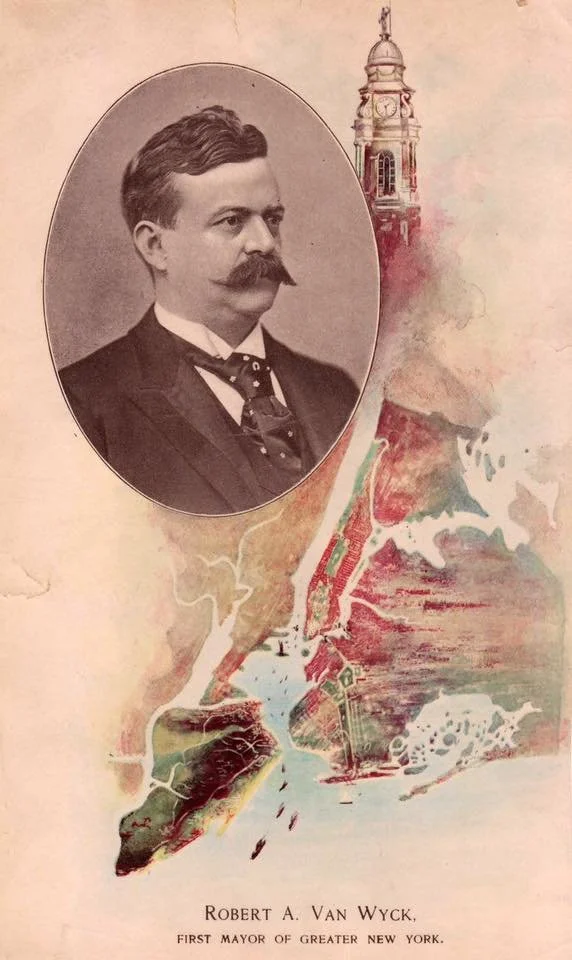
Robert Van Wyck, First Mayor of Greater New York.
From that auspicious beginning, subsequent English charters issued in 1655, 1686, 1708 and 1730 “all provided for an appointed mayor,” according to a 1929 article written by Rebecca Rankin, the City’s principal librarian. By 1775, the mayor was appointed by the Royal Governor, who in turn, was appointed by the King of England. Mayoral duties included Water Bailiff, Clerk of the Markets, and Justice of the Peace, as reported in the 1976 Green Book.
The majority—92 of the 112 mayors—presided over a smallish island, sometimes called Manhattan or New York. In the late 1800s, New York County annexed a large portion of what is now Bronx County including the towns of Morrisania and Kingsbridge. It became the last county in the State in 1914. The mayoral count does not include mayors of the City of Brooklyn or Long Island City… just those from Manhattan. Between 1834 and 1898 the City of Brooklyn had 27 mayors. Seth Low, Mayor of the City of Brooklyn from 1882-1885, went on to become the second elected mayor of the Greater City of New York. Williamsburg received city status in 1851 only to be annexed by the City of Brooklyn in 1854, along with Bushwick. The New York mayors held no sway over Staten Island, Brooklyn, Queens and the many towns and cities located in those counties.
The title page for the 27th Annual Report of the Department of Parks of the City of Brooklyn, shows the changes in governance that occurred between 1897 and 1898. NYC Municipal Library.
On January 1, 1898, the City of New York was transformed, becoming the largest city in the country—second largest in the world, behind London. Government and civic leaders had discussed and debated combining the cities of New York and Brooklyn for approximately 20 years prior to consolidation. Andrew Haskell Green, a storied civic leader whose ventures included creating the New York Public Library and Central Park, is largely credited with the notion of combining the four counties, the annexed Bronx territory and the many small municipalities into one entity.
Green conceived of one great metropolis—a city that had uniform regulations instead of the inconsistent and conflicting rules that made the multiple governments inefficient. Opponents to the scheme expressed concern about taxes—would Brooklyn be saddled with New York’s debt? They also questioned political control: the dread Tammany machine ran politics and government in New York while the Republicans controlled Brooklyn. Brooklyn was the third largest city in the country and its leaders were loath to cede power.
An earlier blog post dealt with the origin of the Greater City of New York, describing efforts that led to the consolidation of unannexed territory and local governments.
Another post showed the evolution of the mayoralty from 1810 when the Council elected the mayor from among its members to direct elections in 1834 (although only a small portion of residents could vote) and the increasing power of the office.
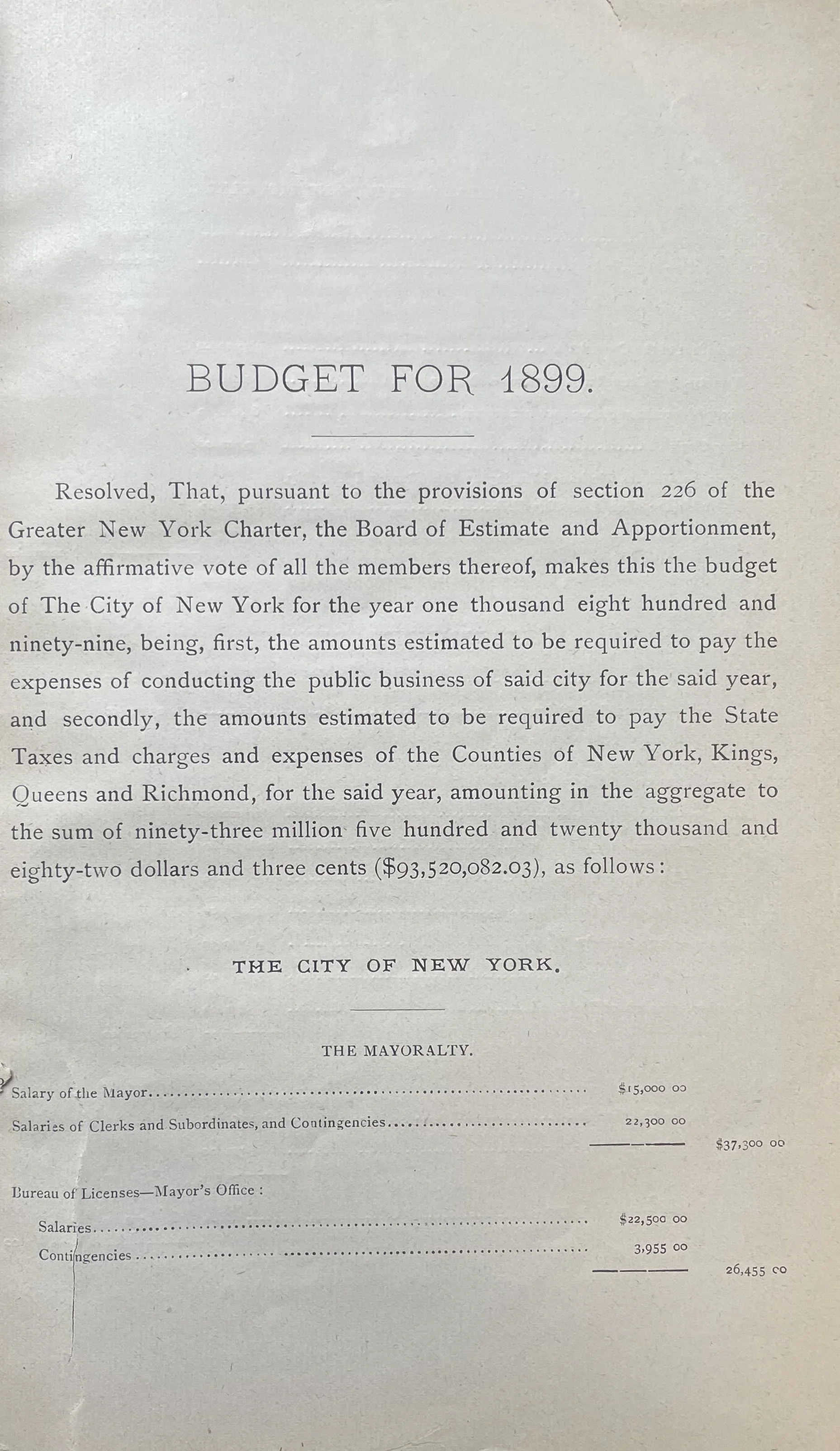
The budget for the fiscal year of 1899 was the first for the consolidated greater New York. NYC Municipal Library.
The creation of the Greater City of New York combined existing municipalities and counties into one government consisting of five boroughs: Brooklyn, the Bronx, New York, Queens and Richmond. A new government was established with a mayor, a board of estimate that included representatives from all of the boroughs as well as the Comptroller. This effectively ended the run of mayors from the preceding governments, including that of New York.
If the question instead is: How many Mayors have represented the Greater City of New York, the city that includes 50 Bronx neighborhoods, 76 in Queens, 77 in Brooklyn, 63 Staten Island neighborhoods and the 57 in Manhattan, the answer is very different. There have been 23 mayors representing the millions of City residents since 1898, including Acting Mayors Ardolph L. Kline, Joseph V. McKee and Vincent R. Impelleteri, who was subsequently elected Mayor.
Some might suggest that this is an outer-borough gripe. But, really it is a claim for full representation of the wonderful diversity that comprises the Greater City of New York.
Remembering Willie Colón, El Malo del Bronx, 1950-2026
Willie Colón, the King of Salsa, was born on 139th Street in the South Bronx on April 28th, 1950. Born William Anthony Colón Román, he was later known as El Malo Del Bronx (based on his debut album title) and referred to as El Maestro. Colón always recalled his Abuela (Grandmother), Antonia Pintorette, originally from Manatí, Puerto Rico, as being his primary caregiver.
Inspired by the street rhythms emanating from congas, bottles, and tin cans that he described as lullabies, Colón picked up the trumpet at age twelve.
On Mayors and the Counting Thereof
This past August, historian Paul Hortenstine noticed that the “Official” list of Mayors failed to include the second term of Mayor Matthias Nicolls (Nicoll). He had served two non-consecutive terms, the first from 1671-1672, and the second from 1674-1675. Hortenstine was not the first to notice this discrepancy. In 1989, the New York Genealogical and Biographical Society published an article by Peter Christoph revealing that every mayor after #7 had been misnumbered. As Christoph pointed out, if a Mayor had two non-consecutive terms the practice was to assign them two numbers, starting with Thomas Willett, who was Mayor #1 and #3. He noted four other early Mayors credited with two terms.
We thought the error might have been due to a little-known hiccup in mayoral history. In July 1673, the Dutch (who had established the colony of New Amsterdam in 1625 and lost it in 1664), invaded and took it back. For fifteen months the colony (renamed “New Orange”) was under a Dutch “Council of War,” that restored the Dutch-style government of a council of Burgomasters and Schepens. As a result, there was not a “Mayor of New York” between July 1673 and November 1674, when the English Governor, Edmund Andros, reappointed Nicolls. Moreover, Nicolls had not been Mayor when the Dutch invaded, his successor, John Lawrence, had assumed that role. So, by all rights, Nicolls served two non-consecutive terms with another Mayor in the middle, making him Mayor #6 and #8. Thereby moving everyone else one place down the line. Lawrence was appointed Deputy Mayor in 1674, but also served another non-consecutive term as Mayor, the 2nd time in 1691, making him both #7 and #20 (under the corrected numbering system).
Mr. George Rex, “The Last Slave”
Recently, the Department of Health and Mental Hygiene (DOHMH) asked the Municipal Archives to participate in a panel discussion The Birth of Identity: Race, Racism, and Personhood in New York City Health Records. Organized by Dr. Michelle Morse, Acting Commissioner and Chief Medical Officer of the DOHMH, the panelists explored the importance of birth certificates and how they record essential facts about a person’s identity. The panel also addressed how race data on birth records informs DOHMH work in pre-natal, maternal wellness, and health outcomes.
…..
To prepare for the panel discussion, City archivists considered whether the Historical Vital Records (HVR) and related vital record ledger collections could potentially augment information about the enslaved children documented in the manumission records. Although vital records for the towns and villages in Brooklyn and Queens, where most of the manumissions took place, only date back to the early 1880s, research in the series is now significantly easier thanks to a completed digitization and indexing project.
View fullsize
Town of Newtown, Queens death ledger, 1881-1897. Historical Vital Record collection, NYC Municipal Archives.
To test their theory, City archivists began reviewing the Town of Newtown, Queens, death ledger (1881-1897), and soon came across a startling entry: No. 982; date of death: March 2, 1885; name of deceased: George Rex; age: 89. In the column for “Occupation,” the clerk wrote, very clearly, “The Last Slave.” Oh!
Jane’s Walk 2025: Walking the Streets of New Amsterdam
For Jane’s Walk (named after urban historian Jane Jacobs), the New York City Municipal Archives participated in two events, a tour of the Archival storage facility in Brooklyn, and a walking tour of lower Manhattan tracing the path of New Amsterdam. The tour will live on in an app, but you too can follow it virtually. The following is a transcript of the author’s tour.